Drone Appeal

Why is the use of drones in warfare so attractive? According to Hugh Gusterson, author of Drone: Remote Warfare Control, there are four main reasons. 

  1. They are the best tools for reconnaissance
  2. They can project power without projecting vulnerability
  3. They are cheap
  4. They are super precise

Reconnaissance

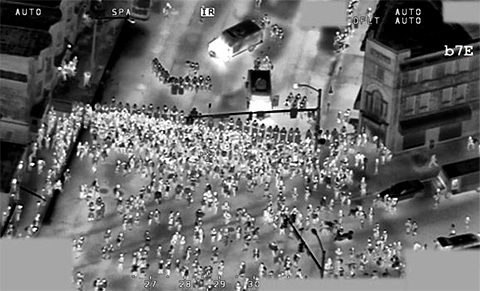
Gathering information is one of the most effective ways to gain power over your enemy. While satellites and manned aircraft can conduct fly overs of certain areas of interest, they cannot stay in the same place for an extended period of time. Drones, on the other hand, can hover over the same location for over a day, surveying who enters and exits buildings and observing all action happening in one area. 
Vulnerability

Unlike manned aircraft, drone pilots are not inside the drone while operating it, but on the ground in a different region operating it from a protected and enclosed space. Using drones allows forces to have a forward presence in the air without the risk of losing someone being shot down in an aircraft. 

This not only benefits operators, but politicians as well. War without American casualties will most likely have less American opposition. It is politically advantageous for politicians to support drone warfare for this reason. 

Price

While drones aren’t “cheap,” they are definitely cheaper than conventional aircraft. According to Gusterson, “…training drone operator costs less than 10% of what it costs to train a fast-jet pilot” (Gusterson, 23). Not only is the training cheaper, but the drone itself is a lot cheaper than other aircraft.

Reaper drone cost: $22 million

F-16 cost: $47 million

Precision

No ground force can match the precision of the laser-guided munition capability of drones. Not only is the technology alone very precise, but the aircraft can linger until it has the perfect shot. The New York Times has referred to the drone’s capabilities as “pinpoint killing.”

Additionally, Gusterson describes how President Barack Obama liked the idea of using drones to pick off dangerous terrorists few at a time without endangering American lives or resulting to the bloodshed of conventional war. 

Thoughts?

From a military standpoint, there seems to be no negatives to implementing drones into American Warfare. But what are the negatives? How does it affect the issue of privacy for those who are under the drones of surveillance? Is there any moral opposition to using technology to fight our wars? 

Source: Gusterson, Hugh.Drone – Remote Control Warfare. Mit Press Ltd, 2017.

Photojournalism: Malnourishment

This photo shows a young mother holding her malnourished son at a medical clinic in the Hodeidah providence of Yemen.

Words to describe my feelings looking at this image? Shocked and saddened. 

This photo captures the problem of world hunger. I caught myself believing the issue has diminished, especially after hearing about the efforts of non-profits who seek to increase access to food around the world. However, it is apparent the problem still persists and those efforts have not reached certain parts of the world. 

Why hasn’t it? Possibly political conflict.

I use to volunteer at the organization Feed My Starving Children back home in Minnesota. After one volunteer session, one of the employees explained to me how the food they ship overseas is often intercepted by hostile groups who prevent it from reaching its respective towns and villages. Some of the conflict is politically motivated like groups in eastern Africa who sabotage relief efforts because of opposition to their government. I wonder if this same type of conflict is contributing to Yemen’s issue of food scarcity.  

In relation to science and technology, I notice the young boy is receiving medical treatment for his ailments, but it is unclear of the type of treatment he is receiving. As Yemen is one of the poorest countries in the Middle East, I imagine his healthcare is inadequate.

It brings to light how often countries who suffer from the most health issues (beyond malnourishment) are the ones that have the least resources to cure them. It also points to how these countries are also the ones that have the least access to vaccines to prevent certain illnesses in the first place.  

How could aiding world hunger be approached best? How could eased political conflict increase access to food and improved medical technology treat those without it?

What “Science” Is Credible?

If you were presented with scientific evidence for a court case, would you rather have that scientific evidence supported by one scientist or many?

I, like I imagine most people, would want scientific evidence supported by many. However, federal law has a different rule when it comes to using scientific support in court. 

In the class reading of Science, Policy and the Value-Free Ideal by Heather E. Douglas, Douglas discusses the shift in the Federal Rules of Evidence and the opinion of Peter Huber, author of Galileo’s Revenge: Junk Science in the Courtroom, on the matter. 

The rule used in the 1920s was called the Frye rule which stated that “only scientific ideas reflecting the consensus of the scientific community were admissible in court” (Douglas, 10). Subsequently, one expert’s opinion would not be enough to be used as evidence in court cases. 

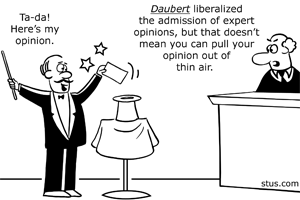
Today’s current rule is the Daubert standard which, as stated by Cornell Law, allows an individual’s expert testimony to be admissible in court 

Huber’s opposition to the Daubert standard revolves around the idea of it bringing “Junk-Science” into the courtroom. In a time where information is more than easily accessible, individuals are able to make scientific claims that may be supported by “evidence,” but lacks credibility and is not reliable. 

A comic making fun of a scientist’s “evidence” being admissible in court.

Instead, Huber believes in the use of “sound science” in the court room which is referred to as well-conducted, careful scientific work that is agreed upon by the scientific community. Huber believes a scientific fact is the collective judgement of a specialized community. Therefore, the only scientific evidence that should be admissible in the court of law should be that agreed upon by a groupof experts, rather than one individual. 

I agree with Huber and wonder; why the heck would the federal government change a law that was to ensure scientific evidence was credible in the court of law? I’m thinking it may have to do with logistics. 

Under the Frye rule, I assume onedoctor’s autopsy report of a murder victim would not be admissible expert testimony. Instead, a group of doctors would all have to examine the victim and come to a consensus, which could turn into a logistics nightmare. 

So, I can understand why Frye’s rule might not be feasible, but I am in great favor to having scientific evidence validated by other scientists before it can be counted as credible. 

Cornell source: https://www.law.cornell.edu/wex/daubert_standard

Amazon: From Bookstore to $1 Trillion Dominator

In this week’s video A Brief History of the Internet you get a glimpse of old-school Amazon. The film is a 1998 PBS documentary that talks about the rapid rise and new uses of the world wide web. At the time, Amazon was one of the first viral stores to build a business. It’s only product at the time? Books. That’s right. Amazon started as a bookstore.

Founder Jeff Bezos thought books were the ideal products to start selling on the web because people didn’t need to touch them before buying them. Plus, the ability to order items on the web and have them delivered to your door was still a new idea which is what gave Amazon an edge on competing bookstores. 

The documentary shows Amazon in their 4thyear of business where it had yet to make a profit, but was valued at over $1 Billion. In September of 2018, Amazon capped it’s value at $1 Trillion. 

In the documentary’s interview, Jeff Bezos said, “It works and it’s extremely efficient and people recognize the value of that.” I would say $1 Trillion sure shows it’s value was recognized. 

When I look at Amazon’s story, I think of how much being “the first” in the rising internet age gave you an advantage. Though Amazon started just as a bookstore, it was able to later  incorporateevery product imaginable into their sales platform because it had such a strong foothold in the world wide web. 

Jeff Bezos in 1998: “I sell books.”
Jeff Bezos in 2017: “I sell whatever the — I want.”

Since everything is online now, it seems like it is impossible to start and have success in any online business because competition is everywhere. In the 1950s, your jewelry store just competed with the one in the next town over, but now your necklaces on Etsy are competing with millions and millions of necklaces just like it from all different parts of the world–all of which are available at the click of a mouse.

The expansion of the internet has definitely allowed more opportunities for entrepreneurship, but it seems as though Amazon won the battle in terms of monumental profit. Since it is so well established and reliable, I find it reasonable to believe many consumers go back to it because they know they can count on it. Though a knock-off site may have the same product for $2 cheaper, many will resort to Amazon knowing it will be tracked, well packaged, and at their doorstep within two days. 

Will there ever be a “new” trillion dollar online commercial breakthrough like Amazon? If so, what could it be?