
If you were presented with scientific evidence for a court case, would you rather have that scientific evidence supported by one scientist or many?
I, like I imagine most people, would want scientific evidence supported by many. However, federal law has a different rule when it comes to using scientific support in court.
In the class reading of Science, Policy and the Value-Free Ideal by Heather E. Douglas, Douglas discusses the shift in the Federal Rules of Evidence and the opinion of Peter Huber, author of Galileo’s Revenge: Junk Science in the Courtroom, on the matter.
The rule used in the 1920s was called the Frye rule which stated that “only scientific ideas reflecting the consensus of the scientific community were admissible in court” (Douglas, 10). Subsequently, one expert’s opinion would not be enough to be used as evidence in court cases.
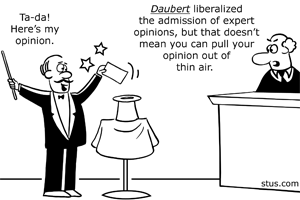
Today’s current rule is the Daubert standard which, as stated by Cornell Law, allows an individual’s expert testimony to be admissible in court
Huber’s opposition to the Daubert standard revolves around the idea of it bringing “Junk-Science” into the courtroom. In a time where information is more than easily accessible, individuals are able to make scientific claims that may be supported by “evidence,” but lacks credibility and is not reliable.
Instead, Huber believes in the use of “sound science” in the court room which is referred to as well-conducted, careful scientific work that is agreed upon by the scientific community. Huber believes a scientific fact is the collective judgement of a specialized community. Therefore, the only scientific evidence that should be admissible in the court of law should be that agreed upon by a groupof experts, rather than one individual.
I agree with Huber and wonder; why the heck would the federal government change a law that was to ensure scientific evidence was credible in the court of law? I’m thinking it may have to do with logistics.
Under the Frye rule, I assume onedoctor’s autopsy report of a murder victim would not be admissible expert testimony. Instead, a group of doctors would all have to examine the victim and come to a consensus, which could turn into a logistics nightmare.
So, I can understand why Frye’s rule might not be feasible, but I am in great favor to having scientific evidence validated by other scientists before it can be counted as credible.
Cornell source: https://www.law.cornell.edu/wex/daubert_standard
 Annalee's Ideas About Science and Global Politics